Pragmatic Lakehouse Architecture — Part 1 of a Series
A Governed, Interoperable, AI-Ready Enterprise Data Framework
Your CEO has a simple request. He wants a Daily Sales Report — one page, on his phone, every morning by seven. Total revenue across all business units, broken down by region and product line. Yesterday’s actuals against the plan.
Eight weeks later, it still does not exist. If you have been in this situation, you know exactly how it happened. Not because your team lacks capability. Not because the data does not exist somewhere. But because the same metric means three different things across three business units. Two of those definitions live in Snowflake. One lives in Databricks. The European subsidiary reports under a recognition policy that differs from the US entity. The Asian operation, acquired eighteen months ago, calculates sales against a product hierarchy that does not map cleanly to yours. Nobody has agreed on exchange rates, reporting periods, or which inter-company transactions to eliminate.
Your AI team offered to help. They built an agent to automate the report. The agent ran. It returned a number — wrong enough that the CFO noticed on day one. The agent had no context for what the metric means in this organization, which inter-company transactions to exclude, or which recognition policy applies to the European entity. Querying raw tables, it returned technically accurate results that were semantically meaningless.
And now — the week you are supposed to deliver the report — your board has approved a merger with a competitor twice your size. The combined leadership team wants a consolidated view within thirty days of close. Your counterpart at the merging company runs entirely on Snowflake. Their definitions, their hierarchies, their fiscal calendar: none of it aligns with yours. Day one of the merger is six weeks away.
The data engineering community has made remarkable progress over the past decade. Modern lakehouse platforms are capable, open standards have matured, and governance tooling has caught up. Yet fragmentation, semantic inconsistency, and the challenge of keeping pace with organizational change persist across enterprises of every size and maturity. The reason is architectural, not technological — the pieces exist, but they have not been assembled into one coherent system designed for the reality of how enterprises actually operate. And now AI has arrived, amplifying every gap in the data estate it runs on.
The Pragmatic Lakehouse Architecture is a response to that reality — shaped not by theory, but by the experience of implementing data architecture in enterprises where the platforms are multiple, the regulatory constraints are real, and the business cannot wait for the architecture to be perfect before it needs answers. It is built on three pillars. First, an architectural pattern that defines how data is organized and governed across zones. Second, a data strategy principle that determines how data flows and how AI and security are embedded from the ground up. Third, an open blueprint guide built from real-world implementation experience. Each addresses a distinct dimension of the problem, and together they form one coherent system.
Pillar 1
Enterprise data architecture has long organized data into progressive stages — raw ingestion, cleaning and conformation, and business-ready aggregation for consumption. The Medallion architecture, introduced by Databricks, formalized this into three named layers: Bronze, where raw data lands exactly as received; Silver, where data is cleaned and conformed; and Gold, where business-ready aggregates are assembled. The principle is sound and widely adopted.
The naming, however, carries an unintended implication. Medallion evokes a prize podium — Gold the first prize, Silver the second, Bronze the third — suggesting a hierarchy of value. In practice every layer is irreplaceable. AI and ML workloads depend on raw Bronze data. Compliance teams trace back to Bronze source records. Data scientists work directly with Silver. No layer is expendable, and the prize-podium metaphor fails to communicate this.
METAllion™ addresses this directly, and differently. Where Medallion has layers, METAllion™ has zones — each with its own purpose, its own ownership, and its own consumer communities, none ranked above the others. The META prefix is not decorative — it names the governance mechanism that runs through every zone.
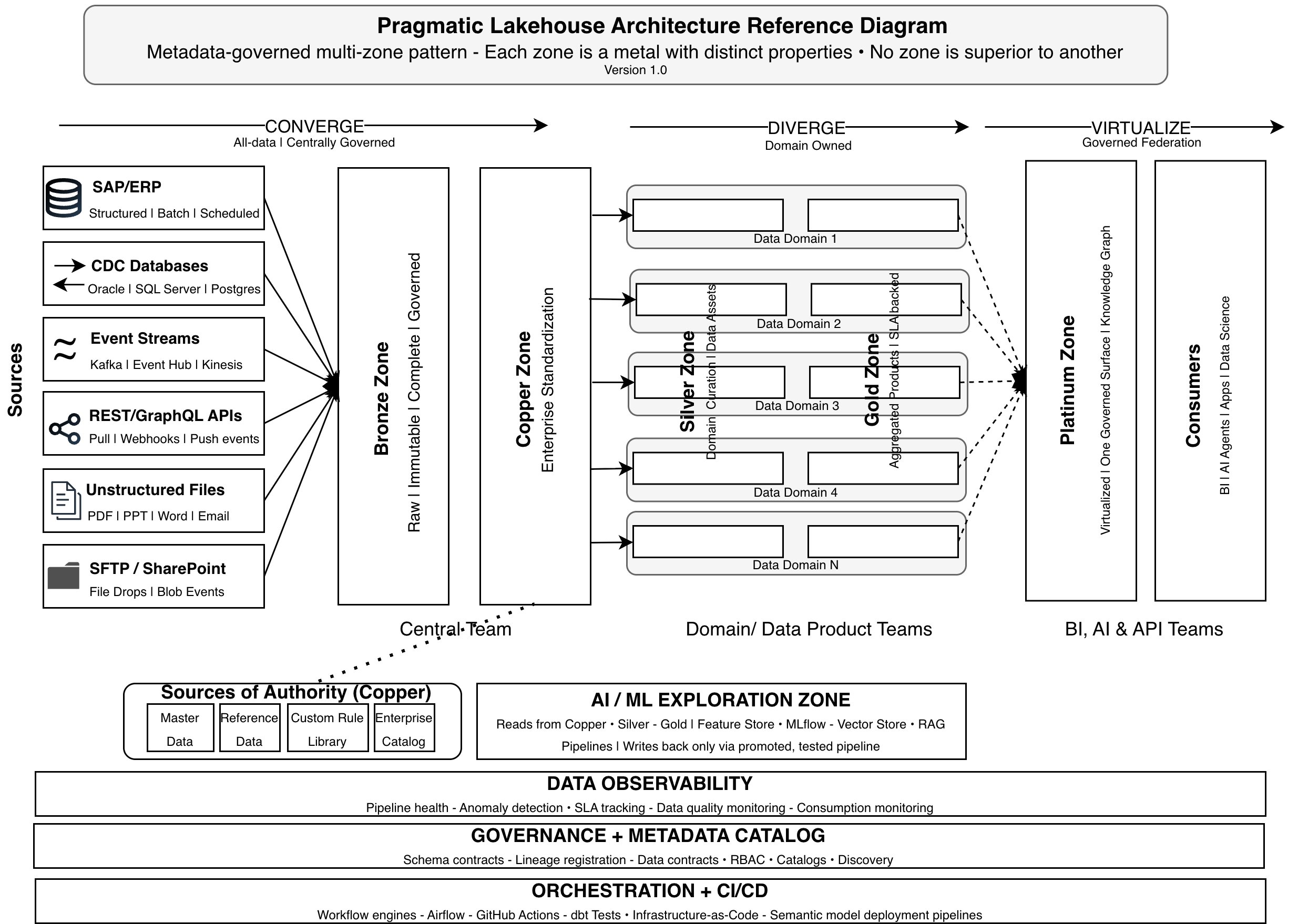
METAllion™ proposes a five-zone pattern. It builds on the progressive data refinement principle of Medallion, redefines the boundaries of Bronze, Silver, and Gold as zones with distinct ownership and purpose, and introduces two brand new zones — the Copper zone, which standardizes data against enterprise-agreed rules before domain teams touch it, and the Platinum zone, which is designed to serve both enterprise cross-domain analytics and AI agents that require governed context beyond what individual Gold zones can provide.
The metal zones carry two meanings in METAllion™. The metals — Bronze, Copper, Silver, Gold, Platinum — describe the structure. The META prefix names what governs every boundary between them. METAllion™ prescribes metadata management as a set of explicit, enforceable ground rules across the entire pattern. Data classification at Bronze — every field typed, tagged, and registered in the enterprise catalog at ingestion. A governed rule library at Copper where standardization rules are owned centrally, not scattered across pipeline code. Data contracts at zone boundaries — formal, versioned agreements between producers and consumers that make implicit dependencies explicit and enforceable. Metric definitions at Platinum — enterprise-agreed calculations that every consumer inherits rather than reimplements. These are the ground rules that make the pattern trustworthy — the catalog as specification, not documentation, enforced at every zone boundary.
| Zone | What it does | Owned by |
|---|---|---|
| Bronze | Raw, immutable, complete. The permanent audit record of what arrived. Classification tags applied at ingestion. | Central team |
| Copper | Enterprise-agreed physical standardization enforced once, centrally. Schema, catalog, master data, and reference data conformance. The starting point for AI, ML, and all domain teams. | Central team |
| Silver | Domain curation. Business rules, joins, deduplication, domain-specific business transformation. Published as data assets with signed data contracts. | Domain team |
| Gold | Aggregated data products. SLA-backed, tested, versioned. Serves domain consumers directly and feeds Platinum for enterprise needs. | Domain team |
| Platinum | Governed federation across all Gold zones. Enterprise metric definitions, knowledge graph, and governed context for AI agents. The enterprise consumption surface. | Federated governance |
Bronze, Silver, and Gold retain their core purpose from Medallion — raw ingestion, domain transformation, and aggregated consumption. What changes is how they are governed: explicit ownership assigned to each zone, metadata contracts enforced at every boundary, and data products published with formal agreements rather than implicit dependencies. The two brand new zones — Copper and Platinum — are METAllion™’s original contributions and deserve a closer look.
At enterprise scale, without a dedicated standardization zone every domain team independently implements the same conformance rules with subtly different outcomes. Copper relocates that work — enforcing it once, centrally, before any domain team touches the data.
Copper enforces enterprise-agreed standards against four sources of authority: schema enforcement ensuring correct physical types for every field; the enterprise catalog providing field classifications and format rules; master data validating incoming identifiers against Product Master, Vendor Master, and Customer Master; and reference data conforming country codes, currency codes, and status lists to enterprise-governed lists or international standards where those lists do not yet exist.
The boundary between Copper and Silver is precise. A date field arriving as a string at Bronze is enforced as ISO 8601 at Copper — physical standardization, decided once for everyone. The fiscal quarter treatment that determines which quarter that date belongs to in this domain is applied at Silver — domain-specific business transformation, owned by the team accountable for it.
AI has its most tractable role at Copper. Field classification at enterprise scale — profiling thousands of columns across dozens of source systems — is precisely the pattern recognition work AI accelerates. An AI-assisted pipeline profiles Bronze data, generates conformance rules from the catalog and master and reference data, and flags exceptions for human approval. AI participates in building the data estate at Copper, then reads from Copper upward as a governed consumer.
Where platform capabilities permit, open table formats at Bronze — Delta Lake, Apache Iceberg — combined with cross-platform sharing capabilities such as Snowflake Data Sharing and Databricks Delta Sharing, can eliminate the physical copy at ingestion. Data is read directly at the source through open standards. Copper, however, always materializes a physical copy — standardization, type enforcement, and master data validation cannot be applied without it.
Gold zones serve domain consumers well. A Finance Gold zone delivers accurate P&L data for Finance. A Sales Gold zone delivers accurate pipeline data for Sales. Each is correct within its own context. But when the CEO asks for total revenue across all business units, no single Gold zone can answer that question — and asking each domain team to agree on one definition at query time is where eight-week delays originate. Platinum exists to solve this once, permanently. It federates across all Gold zones through shortcuts, mirroring, and live federation, presenting one governed consumption surface without moving data. Enterprise metric definitions — calculation logic, entity scope, recognition policy, currency treatment — are agreed once and encoded in Platinum. Every executive dashboard and every cross-domain report inherits that definition automatically.
The second problem Platinum solves is more consequential for the AI era. An AI agent querying raw tables returns technically accurate numbers that are semantically meaningless — it has no understanding of what revenue means in this organization, which entities are in scope, or how the regional hierarchy maps to legal entities. The Platinum zone is where that context lives. Through a knowledge graph that encodes enterprise metric definitions, entity relationships, organizational hierarchies, and business rules, AI agents can traverse context rather than just retrieve data. They inherit the organization’s agreed answer — with the full reasoning chain that makes it explainable.
Pillar 2
The METAllion™ zones define the structure. Converge → Diverge → Virtualize (CDV) is the data strategy principle that determines how data moves through them, who owns it at each stage, and how AI and security are embedded from the ground up. Security is not configured separately at each zone — it originates as a classification at Bronze and travels as a metadata contract through every zone that follows.
This principle did not emerge in a vacuum. Two established frameworks shaped its thinking. Data Mesh, introduced by Zhamak Dehghani, established domain ownership and data as a product. Data Fabric, as defined by Gartner, established unified, platform-neutral access through active metadata. The CDV Principle brings the best of both — the centralized governance of Data Fabric where it is needed, and the domain autonomy of Data Mesh where it belongs.
| Phase | Zones | Governing philosophy |
|---|---|---|
| Converge | Bronze, Copper | Data Fabric — unified access, centralized governance, one catalog, one standard applied to all sources. |
| Diverge | Silver, Gold | Data Mesh — domain ownership, data as a product, signed data contracts, full domain accountability. |
| Virtualize | Platinum | PLA — governed federation, enterprise metric definitions, knowledge graph for AI agents, virtualization first. |
Before the blueprints address the practical, real-world constraints of implementation, the reference architecture brings the METAllion™ Pattern and the CDV Principle together as one complete view — the architecture as it is designed to work.
Pillar 3
The METAllion™ Pattern and the CDV Principle together address the foundational questions of enterprise data architecture. What they cannot control is the estate you are asked to apply them to — legacy platforms that cannot be retired, regulatory regimes that conflict across jurisdictions, governance tooling that lags the architecture it is supposed to support, and organizations that merge before their data does. The third pillar exists because in enterprise data architecture, these are the operating conditions.
PLA Open Blueprints are distilled from real implementation experience — named patterns for specific real-world constraints, each grounded in the CDV Principle, each preserving the integrity of the METAllion™ Pattern while accommodating the reality it operates in. Several are directly relevant to the opening story. More address the broader constraints every enterprise faces.
Adopting METAllion™ — Start Where It Hurts — The architecture does not require a full implementation to deliver value. Each zone solves a specific problem and can be adopted independently. Start at Copper if fragmented definitions are the pain. Start at Platinum if the merger is six weeks away. Start at Bronze and Copper if AI readiness is the priority. Modular by design, not sequential by requirement.
Federate First. Consolidate Later. — Two data estates, two platforms, leadership needing a combined view within days of close. The Platinum zone federates the acquired company’s Gold zone alongside yours without moving data. Enterprise metric definitions are agreed and encoded in Platinum. Leadership sees the consolidated picture before a single pipeline is rebuilt.
Beyond Retrieval. Context for AI. — The AI agent that embarrassed the CFO had access to the data. What it lacked was context. The knowledge graph at Platinum encodes enterprise metric definitions, entity relationships, organizational hierarchies, and business rules. The agent does not just retrieve a number — it traverses the context that makes the number meaningful and its reasoning explainable.
Further blueprints covering compliance, global deployment, multi-platform estates, and more will be covered in depth in this series.
The CEO still wants his report. Eight weeks in, two platforms, one impending merger, one AI agent that embarrassed the CFO.
The fragmented data estate. The Copper zone enforces enterprise catalog, master data, and reference data conformance before any domain team touches the data. Every domain — Finance, Sales, the European subsidiary, the acquired Asian operation — starts from the same standardized foundation. The Platinum zone defines the enterprise metric once: calculation logic, entities, inter-company eliminations, recognition policy. Every consumer inherits that definition. There is no negotiation at report time. The governance happened upstream, in the zones.
The AI agent that got it wrong. The CDV Principle makes AI-readiness an architectural property, not a configuration. The agent queries the Platinum zone and inherits one enterprise-agreed definition — correct exclusions, correct recognition policy, correct access controls already applied. Through the knowledge graph at Platinum, the agent does not just retrieve a number — it understands what that number means, how it was calculated, and why. The agent did not become smarter — the architecture became governed.
The merger on the horizon. The Platinum zone federates the merger counterpart’s Gold zone alongside yours without moving data. Enterprise metric definitions are agreed and encoded in Platinum. Leadership sees the consolidated picture before a single pipeline is rebuilt.
The METAllion™ Pattern, the CDV Principle, and the PLA Open Blueprints working together — the report exists, it is governed, and it will be there every morning by seven.
This is Part 1 of a series. Each PLA Open Blueprint gets its own deep-dive article — the implementation detail, the diagram, the key principle, and the real-world context that makes it actionable.
PLA Open Blueprints is a living framework. A community platform and implementation accelerators for the Copper and Platinum zones are in development.
Governed. Interoperable. AI-Ready.
METAllion™ Pattern — CDV Principle — PLA Open Blueprints.
Built for the enterprise data reality you actually have — not the one you planned for.
Medallion Architecture
Databricks. Medallion Architecture. Databricks Glossary.
databricks.com/glossary/medallion-architecture
Data Mesh
Dehghani, Zhamak. Data Mesh Principles and Logical Architecture. Martin Fowler, 2020.
martinfowler.com/articles/data-mesh-principles.html
Data Fabric
Gartner. Data Fabric. Gartner Information Technology Glossary.
gartner.com/en/data-analytics/topics/data-fabric
© 2026 Hari Abburu. METAllion™ is the author's trademark. All rights reserved. Licensed under CC BY-NC 4.0.